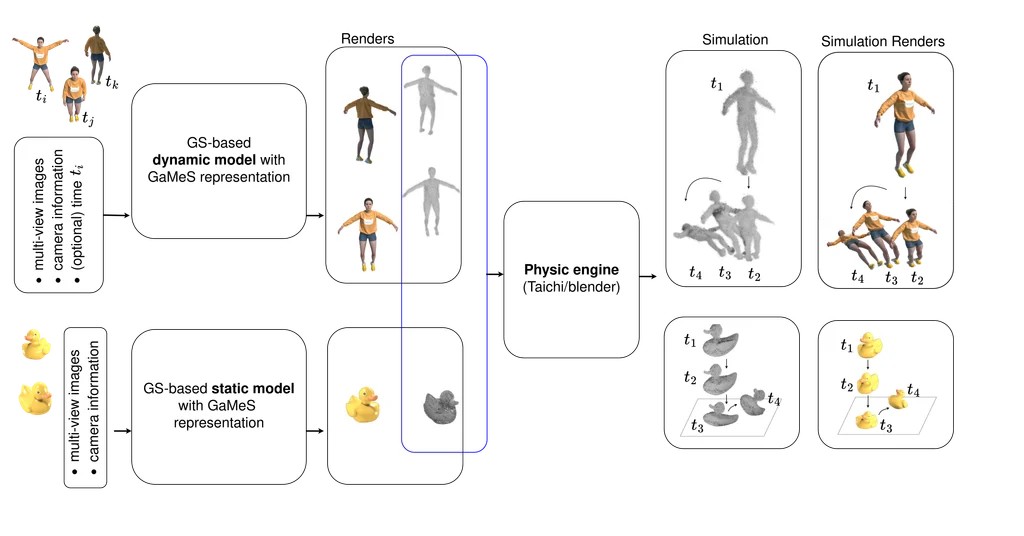
Physics simulation is essential for modeling and utilizing 3D scenes in various real-world applications. However, integrating with state-of-the-art 3D scene rendering techniques such as Gaussian Splatting (GS) remains challenging. Existing models use additional meshing mechanisms, including triangle or tetrahedron meshing, marching cubes, or cage meshes. Alternatively, we can modify the physics-based Newtonian dynamics to align with 3D Gaussian components. Current models use a first-order approximation of a deformation map, which locally approximates the dynamics using linear transformations. In contrast, our GS for Physics-Based Simulations (GASP) pipeline uses parametrized flat Gaussian distributions. Consequently, the problem of modeling Gaussian components using the physics engine is reduced to working with 3D points. In our work, we present additional rules for manipulating Gaussians, demonstrating how to adapt the pipeline to incorporate meshes, control Gaussian sizes during simulations, and enhance simulation efficiency. This is achieved through the Gaussian grouping strategy, which implements hierarchical structuring and enables simulations to be performed exclusively on selected Gaussians. The resulting solution can be integrated into any physics engine that can be treated as a black box. As demonstrated in our studies, the proposed pipeline exhibits superior performance on a diverse range of benchmark datasets designed for 3D object rendering.
Authors: Piotr Borycki, Weronika Smolak, Joanna Waczyńska, Marcin Mazur, Sławomir Tadeja, Przemysław Spurek